
How to Choose the Right Heat Press for Sublimation: A Beginner’s Guide
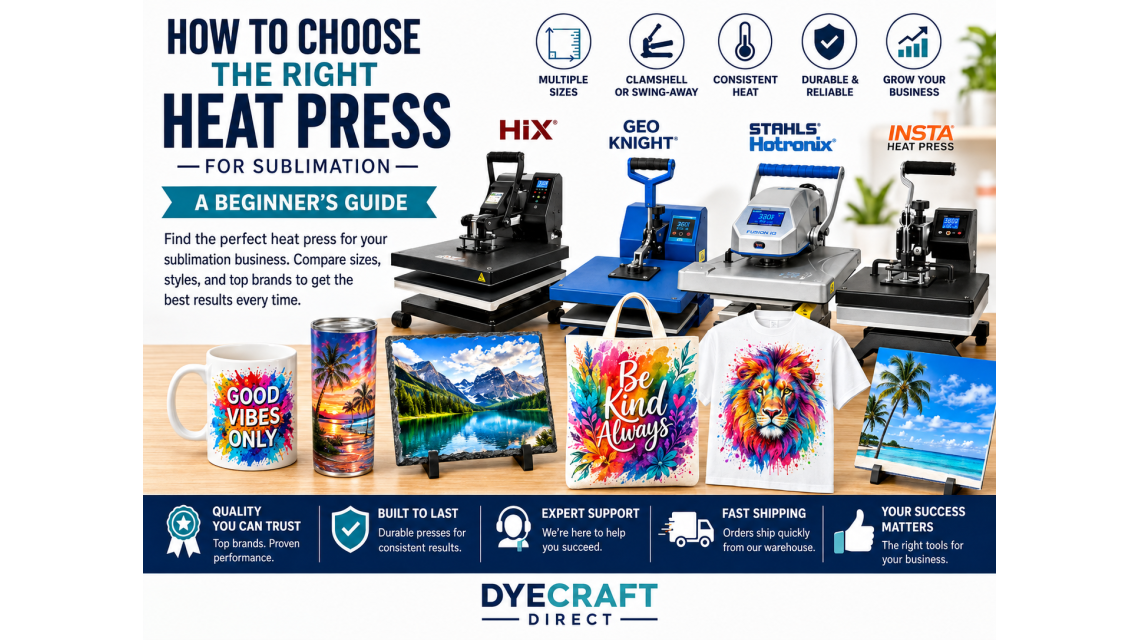
How to Choose the Right Heat Press for Sublimation: A Beginner’s Guide
If you're getting started with sublimation, choosing a heat press can feel a little overwhelming.
There are clamshell presses, swing-away presses, automatic presses, different platen sizes, mug presses, tumbler presses, and machines at very different price points.
So how do you know which heat press is right for you?
The answer depends on what you plan to make, how much space you have, how often you'll use the press, and how much room you want to give your business to grow.
A heat press is one piece of equipment I wouldn't choose based on price alone.
Your press is responsible for applying the heat and pressure that transfers your sublimation image to the product. If the heat or pressure isn't consistent, your finished products may not be consistent either.
Let's look at what you should consider before buying one.
Quick Answer: What Heat Press Should a Beginner Buy?
For many beginners who want to make shirts, tote bags, aprons, photo panels, slates, plaques, cutting boards, and other flat sublimation products, a 15" x 15" or 16" x 20" flat heat press is a practical starting point.
A 15" x 15" press gives you plenty of room for many common projects without taking up as much workspace.
A 16" x 20" press gives you additional room for larger designs and products and may be a better choice if you expect your business to grow.
But size isn't the only decision.
You also need to decide whether a clamshell, swing-away, automatic, or pneumatic press makes the most sense for the products you want to create.
Clamshell vs. Swing-Away Heat Press
Two of the most common flat heat-press styles are clamshell and swing-away.
Clamshell Heat Press
A clamshell press opens upward like a clamshell.
The upper heated platen lifts while the lower platen stays in place.
One advantage of this design is that it generally requires less operating space because the upper platen opens upward rather than swinging to the side.
A clamshell press can be a good choice for:
T-shirts
Tote bags
Aprons
Pillow covers
Fabric blanks
Thin flat sublimation products
Heat-transfer vinyl
Transfer papers and other apparel applications
For a home business or smaller workspace, the compact design can be especially helpful.
Swing-Away Heat Press
With a swing-away press, the upper heated platen lifts and moves completely away from the lower platen.
This gives you unobstructed access to the product while you're positioning your transfer.
Swing-away presses can be especially useful when working with thicker or rigid sublimation products.
Depending on the machine and product, this might include:
Photo slates
Photo panels
Plaques
Glass cutting boards
Ceramic products
Hardboard
Tiles
Awards
Other thicker sublimation blanks
Having the heating element moved out of the way also makes it easier to carefully position certain products and transfers.
What Size Heat Press Should You Buy?
Heat presses come in many sizes, but two popular sizes for small personalization businesses are 15" x 15" and 16" x 20".
15" x 15" Heat Press
A 15" x 15" press can be a good choice for a beginner because it's large enough for many common projects while still fitting into a smaller workspace.
You can use it for many:
Shirts
Tote bags
Aprons
Pillow covers
Photo products
Small signs
Plaques
Fabric blanks
If you're working from home or have limited space, this may be all the press you need to get started.
16" x 20" Heat Press
A 16" x 20" press gives you more working area.
That can be useful if you plan to make:
Larger shirts
Large transfers
Bigger tote bags
Larger photo panels
Oversized artwork
Larger home décor products
Production orders
If you know you're serious about growing your business, buying a little more press than you need today can sometimes keep you from having to upgrade as quickly.
Manual vs. Automatic Heat Presses
Another consideration is how the press opens and closes.
Manual Heat Press
With a manual press, you physically lower and raise the press.
For a beginner or lower-volume business, this can be perfectly suitable.
The important thing is learning how your press works and using consistent settings.
Auto-Open Heat Press
An auto-open press releases automatically when the timer finishes.
This can be helpful if you're working on several things at once because you don't have to stand directly beside the press waiting for the timer.
It can also help reduce the possibility of accidentally leaving a product under heat longer than intended.
Pneumatic or Air-Operated Heat Press
Higher-production businesses may eventually consider an air-operated press.
These machines use compressed air to apply pressure and can reduce the physical effort required when you're pressing large quantities of products.
You don't necessarily need one when you're starting.
Choose equipment based on the amount of work you're actually doing.
HIX Heat Presses
HIX is one of the heat-press brands we carry at DyeCraft Direct.
You'll find different styles and sizes, including clamshell and swing-away machines.
If you're comparing HIX presses, think about:
Your available workspace
The products you plan to press
Platen size
How often you'll use the machine
Whether you prefer clamshell or swing-away operation
Geo Knight Heat Presses
Geo Knight offers several types of heat presses, from smaller-format machines to larger production equipment.
Their selection can be worth considering if you want a swing-away press or equipment that gives you room to expand into different types of products.
Before choosing a model, think about the products you'll make most often.
A person primarily making shirts may have different needs from someone creating photo slates, plaques, glass cutting boards, tiles, and other hard substrates.
Stahls / Hotronix Heat Presses
Stahls Hotronix is another option for businesses looking for professional heat-press equipment.
There are different configurations available, including clamshell, auto-open, and higher-production options.
For a growing business, features that make repetitive pressing easier can become increasingly important.
Think about how many products you expect to press in a day.
What feels unnecessary when you're making five shirts may become very valuable when you're making fifty.
Shop Stahls / Hotronix Heat Presses
Insta Heat Presses
Insta heat presses are another professional option available from DyeCraft Direct.
You'll find different platen sizes and press configurations to match different production needs.
When comparing Insta equipment, consider whether you need a compact machine for a smaller workspace or a larger machine for higher-volume and oversized work.
Which Heat Press Is Best for Shirts?
If shirts and apparel will be the main part of your business, a clamshell press can be a very practical choice.
A 15" x 15" machine can handle many common apparel designs.
A 16" x 20" machine provides more room for larger transfers and garments.
Also think about whether you'll be pressing:
Sublimation
Heat-transfer vinyl
DTF transfers
Transfer paper
Other heat-applied graphics
If your business will primarily involve apparel, convenience and production speed may matter as much as platen size.
Which Heat Press Is Best for Sublimation Blanks?
If you're planning to make a wide variety of hard sublimation products, I would pay close attention to clearance, pressure adjustment, and access to the lower platen.
Products such as photo slates, plaques, glass cutting boards, photo panels, and other rigid blanks are very different from a thin polyester shirt.
A swing-away press can be useful because it gives you more room to position your product without working directly underneath the hot upper platen.
Before ordering any blank, make sure it fits your press and follow the pressing instructions for that particular product.
What About Mugs and Tumblers?
A flat heat press isn't designed to press every sublimation product.
Mugs, tumblers, and other curved drinkware usually require equipment designed to apply heat and pressure around the shape of the product.
Depending on what you're making, you may need:
A mug press
A tumbler press
A compatible mug heating element
A mug wrap
Another appropriate heating method
Don't assume one heating element fits every mug or tumbler.
Diameter, height, shape, coating, and equipment compatibility all matter.
What Products Can You Make With a Flat Heat Press?
This is one reason I like flat heat presses for sublimation businesses.
One machine can give you access to many different product categories.
Depending on the press and the specific blank, you may be able to create:
T-shirts
Tote bags
Lunch bags
Cosmetic bags
Aprons
Pillow covers
Socks
Mouse pads
Photo panels
Photo slates
Plaques
Glass cutting boards
Coasters
Ornaments
Hardboard products
Fabric blanks
Awards
Home décor
That gives you room to experiment without buying a completely different machine every time you want to add another flat product.
Don't Buy a Heat Press Based Only on Price
This is something I want beginners to think seriously about.
A heat press is not just another supply.
It is one of the main pieces of equipment responsible for your finished product.
If a machine doesn't maintain consistent heat or pressure, you may find yourself troubleshooting problems that aren't actually caused by your printer, ink, paper, or blank.
That can lead to:
Wasted blanks
Wasted ink
Wasted transfer paper
Remakes
Lost production time
Frustrated customers
Sometimes spending less at the beginning can cost more later.
Look at the entire value of the machine rather than only the price tag.
Check Your Electrical Requirements
Before ordering a heat press, check its electrical requirements.
Make sure your workspace has the correct electrical service for the exact machine you're purchasing.
Larger or higher-production presses may have different electrical requirements than smaller machines.
Never assume that every press plugs into the same type of outlet.
If you're unsure, ask before ordering.
Think About Your Workspace
Heat presses take up more room than the physical dimensions of the machine itself.
You also need space to:
Open the machine safely
Swing the platen if you're using a swing-away press
Lay out your transfers
Prepare your blanks
Allow hot products to cool
Store protective paper, tape, pads, and accessories
Plan your workspace before the machine arrives.
A swing-away machine in particular needs room to move to the side.
Think About What You Want to Make Six Months From Now
Beginners naturally think about what they want to make today.
I also want you to think about what you might want to make six months or a year from now.
Maybe you're starting with shirts.
But will you eventually want to add:
Tote bags?
Photo slates?
Cutting boards?
Plaques?
Awards?
Larger photo panels?
Business orders?
You don't need to buy the biggest machine available.
But thinking ahead can help you choose a press you won't immediately outgrow.
Keep a Time and Temperature Record
Once you have your press, keep notes.
Write down:
Product
Time
Temperature
Pressure
Protective paper used
Pressing direction
Cooling instructions
Finished result
If you make a beautiful product today, you want to be able to reproduce that same result next week.
Don't depend on memory.
Your settings may also vary depending on the blank and the press you're using.
View DyeCraft Direct's Sublimation Time and Temperature Guide
Common Heat Press Mistakes to Avoid
Buying Before Deciding What You Want to Make
Choose your product direction first.
Then choose equipment that can handle those products.
Buying Too Small
A small press may cost less, but it can limit your design and product sizes.
Buying Too Large for Your Workspace
Make sure you have room to safely operate the machine.
Assuming Every Product Uses the Same Settings
Different sublimation blanks may require different time, temperature, pressure, and pressing techniques.
Changing Several Settings at Once
If something doesn't come out correctly, troubleshoot one variable at a time.
Ignoring Pressure
Temperature gets a lot of attention, but pressure matters too.
Not Testing New Products
Make a test product before running a large customer order whenever possible.
Which Brand Should You Choose?
There isn't one heat press that's perfect for every business.
That's why we carry several established brands.
Your best choice depends on:
Your budget
Your workspace
Your production volume
Your preferred press style
The products you want to make
The platen size you need
Whether you want manual, auto-open, or air-operated equipment
The goal isn't to buy the most expensive press.
The goal is to buy the right press for the work you plan to do.
Final Recommendation
For many beginners, a quality 15" x 15" or 16" x 20" flat heat press provides a strong foundation for a sublimation business.
If you're mostly creating apparel and fabric products, a clamshell may be a practical choice.
If you're planning to work with thicker hard substrates and want more access to the lower platen, take a serious look at swing-away presses.
If production increases, automatic and pneumatic options may become worth considering.
Most importantly, don't choose your press based on price alone.
A reliable heat press is an investment in every product that comes out of your shop.
Take your time.
Think about what you want to make.
Think about where you want your business to go.
And if you're not sure which machine fits your needs, ask before you buy.
That's what we're here for.
Shop Heat Presses at DyeCraft Direct
Shop Stahls / Hotronix Heat Presses
View the Sublimation Time and Temperature Guide
Need help choosing the right heat press for your sublimation business?
Contact DyeCraft Direct at 908-842-8082.
Shop Our Products Online
If you cannot visit us in person, you can still shop DyeCraft Direct online 24/7. Browse our product collections below:
- DyeCraft Direct Home
- View All Products
- Sublimation Blanks
- Sublimation Mugs & Drinkware
- White Sublimation Mugs
- Color Changing Mugs
- Printers
- Heat Presses
- Inks
- Transfer Papers
- Jewelry & Dog Tags
- Keychains
- Photo Panels
- Puzzles
- Sleeves & Bags
- Fabric Blanks
- Ornaments
- Contact Us
Visit DyeCraft Direct
DyeCraft Direct
216 US Highway 206, Suite 7
Hillsborough, NJ 08844
Phone: 908-842-8082
Website: www.dyecraftdirect.com
Store Hours: Monday through Friday, 9:00 AM to 5:00 PM
Whether you want to shop in person, explore quality sublimation products, or get help choosing the right products and equipment, DyeCraft Direct is here to help you shop, learn, create, and grow with confidence.
Keep Learning With DyeCraft Direct
Want more sublimation ideas, product demonstrations, helpful tips, new products, and creative inspiration? Stay connected with DyeCraft Direct.
Follow DyeCraft Direct on Facebook
Subscribe to DyeCraft Direct on YouTube
Keep learning. Keep creating. And see where your sublimation journey can take you.
Leave a Comment